
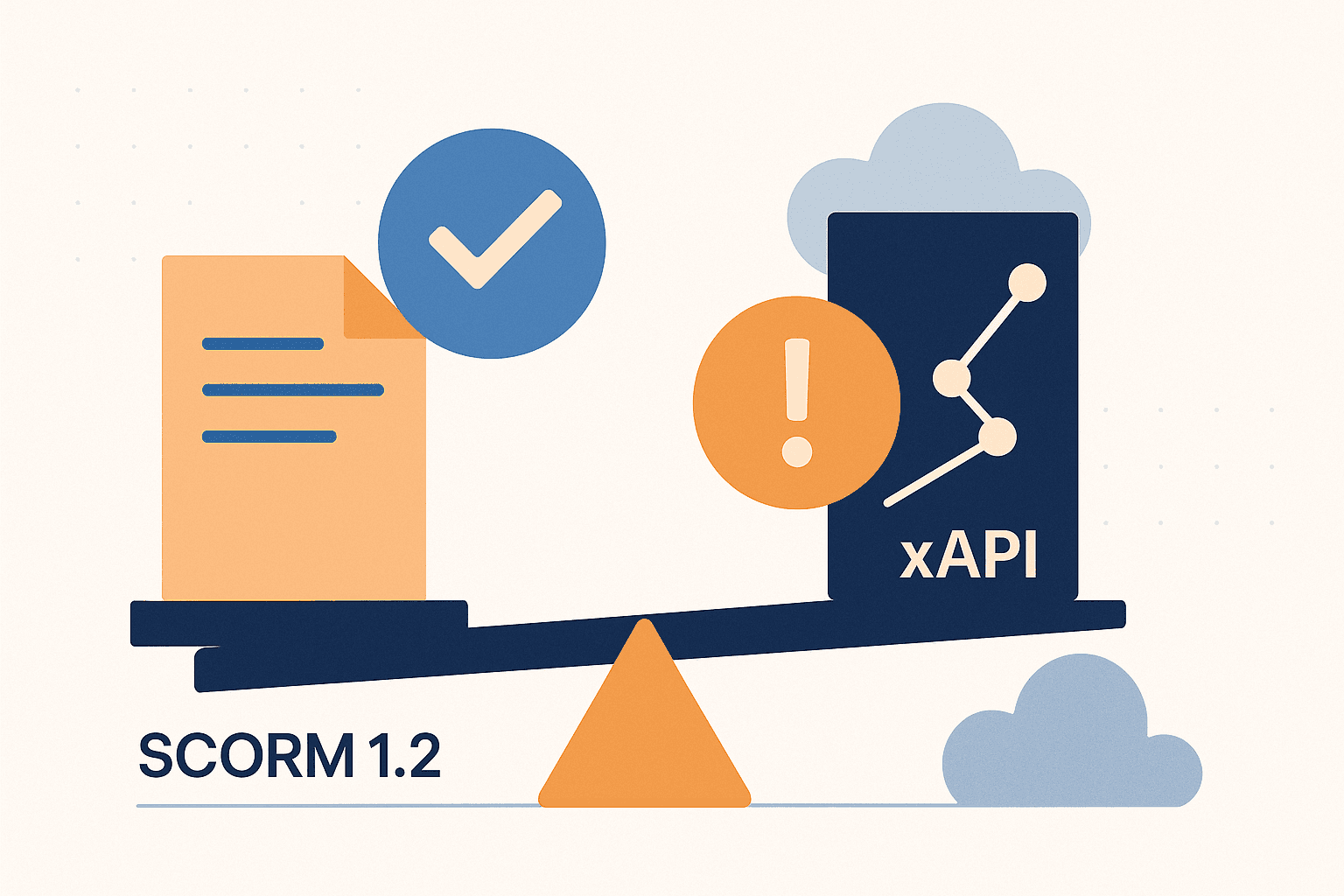
"Which standard should we use?" is the wrong opening question 80 % of the time. Before you weigh SCORM 1.2 vs xAPI vs cmi5, ask: do your employees actually need to import content from third-party authoring tools, or are you only ever creating your own?
A short tour of the standards
| Standard | Year | Core idea | Today's reality |
|---|---|---|---|
| SCORM 1.2 | 2001 | Authoring tool (Articulate, iSpring) exports a ZIP package, LMS imports it | Still the most common — 80 % of packaged content ships as SCORM 1.2 |
| SCORM 2004 | 2004 | Better tracking + sequencing | Less adopted, complex |
| xAPI (Tin Can) | 2013 | Sends "statements" (actor-verb-object) to a Learning Record Store | Hot in education, rare in B2B |
| cmi5 | 2016 | xAPI + SCORM-style sequencing | Almost never seen in practice |
When you need SCORM 1.2
If any of these apply, you need SCORM:
- You buy pre-built content from vendors (Skillsoft, LinkedIn Learning, industry providers)
- Your team already uses Articulate Storyline, iSpring Suite, or Adobe Captivate
- You have compliance content that needs a single-package export for audit purposes
Practical behaviour: SCORM 1.2 tracks time spent, score achieved, completion status. That's enough for 95 % of corporate compliance training.
When you need xAPI
You need xAPI if you're doing:
- Microlearning with off-LMS tracking (e.g. "user watched a 3-minute GDPR video")
- Mobile / offline scenarios — xAPI can store statements locally and sync later
- Real-time analytics wired into a separate BI system
- Simulations and VR — xAPI has a better format for rich events
In practice: 90 % of SMB B2B usage does not need xAPI. It's a tool for larger orgs with their own L&D team and BI stack.
When you need neither
Plot twist: if you create the content yourself and only show it to your own employees, you need neither SCORM nor xAPI.
The standards exist for one main reason: interoperability between authoring tools and LMSes. If you write content directly inside the LMS (text + video + quiz), don't import ZIP packages, and never plan to migrate to another LMS, every standard adds technical overhead with no business benefit.
Modern cloud-native LMS platforms (Mentor is one) build modules natively: rich text, video upload, quiz editor, AI assistance. No ZIP, no package format. Faster to author, more flexible, works on mobile without adaptation.
How Mentor handles this
Our choices:
- SCORM 1.2 import: yes. Pre-built vendor content is a B2B reality. You have an old Articulate package — drop it in, it plays in a sandboxed iframe.
- SCORM 1.2 export from Mentor: no. Content you create in Mentor is yours and accessible to your employees — you don't need an export to take it elsewhere, because Mentor doesn't operate as vendor lock-in.
- xAPI: no. ROI is too small for our target audience (SMB / mid-market).
- Native module authoring: the main feature. Rich text with TipTap, video via Cloudflare Stream, AI-generated quizzes from content.
In short
- Buying pre-built content → you need SCORM 1.2 import
- Writing your own content → no standards needed
- xAPI = for larger L&D orgs, not SMB
If you write your own content and want an LMS with an AI assistant for module authoring, Mentor offers a free 14-day trial.